No photo yet
Utter Chaos
Zoanthus sp.



Species profile
Zoanthus sp.
Also sold as: Sonic Flares, Sonic Flare zoa, Sonic Flare zoanthid
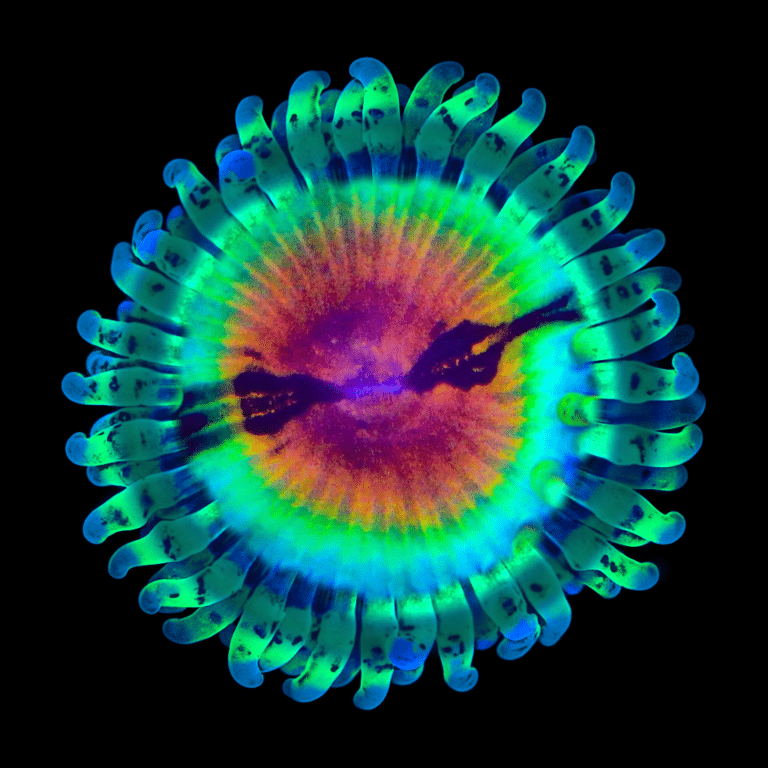
Sonic Flare is a larger-polyp zoanthid with a pink-flecked deep blue center, a sunburst ring of coral-orange spokes and a pale band, and curling blue to teal tentacles.
Colors
Deep blue to indigo center dusted with fine pink to coral specks, around a small pale blue raised mouth; a sunburst ring of pink to coral-orange spokes alternating with dark blue to purple stripes; a pale peach to creamy white band, edged in places with yellow-green; a turquoise to teal zone at the base of the tentacles; and curling blue to deep teal tentacles
Easy
Medium
75-150 PAR
Moderate
Moderate
Lower to middle rockwork, ideally a spot near the front of the tank where the sunburst centers can be seen up close
75 to 80°F (24 to 27°C)
1.024-1.026 specific gravity (about 32-35 ppt)
Mostly light-fed, with optional fine foods once or twice a week.
Photosynthetic; optional fine particulate food once or twice a week
Sonic Flare is a ringed morph, and the sunburst on each face is the main draw. A deep blue center flecked with pink sits inside a ring of pink to coral-orange spokes, then a pale cream band, then turquoise to teal before the curling blue tentacles. It is a larger-polyp zoa, so even a small frag shows up well. Under strong blue light the colors look more intense, and under whiter light they look softer. Frags are often sold as a few polyps, so give a new piece time to settle before judging its growth. This is the look most sellers use for the name, but a few sellers use it for different-looking zoas, including a pink-and-maroon one, so buy from photos of the actual colony. Moderate, indirect flow keeps detritus off the faces without keeping the polyps closed.
Like any zoanthid, Sonic Flare may contain palytoxin, so treat it as toxic. Wear gloves and eye protection when handling or fragging, and wash up afterward.
Zoanthus sp.
Zoanthus sp.
Zoanthus sp.

Palythoa sp.